
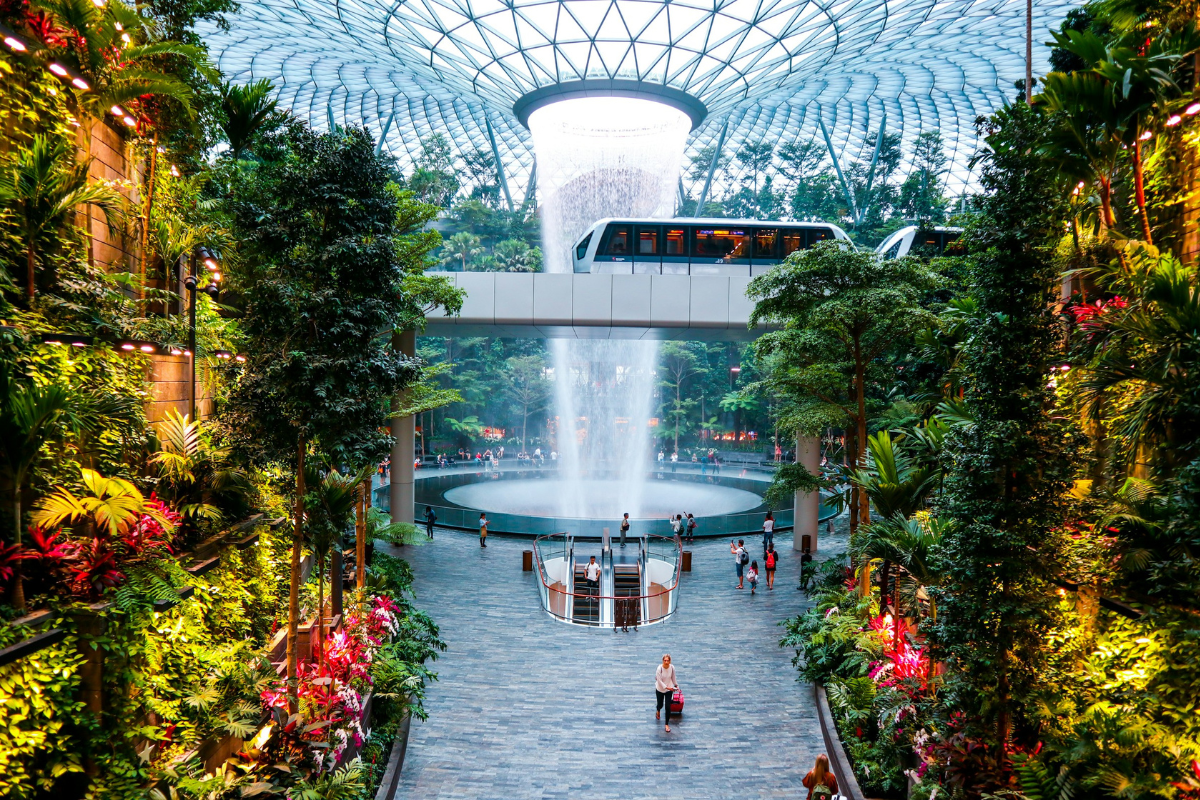

Airports are increasingly using water to reshape how they present themselves to travelers and cities alike.
As the aviation industry reassesses not just the operational aspects of airports but also their cultural significance, water plays a key role in rebranding some of the world’s largest transportation centers. Jewel Changi Airport, for instance, made international headlines for its Rain Vortex, which made the airport terminal a popular destination for photos and travel. Waterfalls, tropical planting, and climate-controlled landscapes have helped transform the airport into a destination rather than a transit point. The impact of such projects has changed expectations for airport design. Rather than simply expanding commercial space in the terminal, more airports are incorporating features that emphasize water sensitivity, such as recycled water technologies, wetlands, interior gardens, and climate-sensitive architecture, to calm travelers while demonstrating their commitment to sustainability.
Airports Are Rebranding Through Water as Experience
Few airports illustrate this transformation more clearly than Jewel Changi Airport. The Rain Vortex, surrounded by thousands of trees and shrubs, has become one of the most iconic places at any airport worldwide. The waterfall functions as more than a visual attraction. It positions the airport around ideas of tropical ecology, atmosphere, and environmental calm.
Beyond the show lies an environmental plan. Changi’s use of recycled NEWater reflects a broader effort to prepare for heavier rainfall and long-term climate pressure. Here, water serves not only as infrastructure but also as identity.
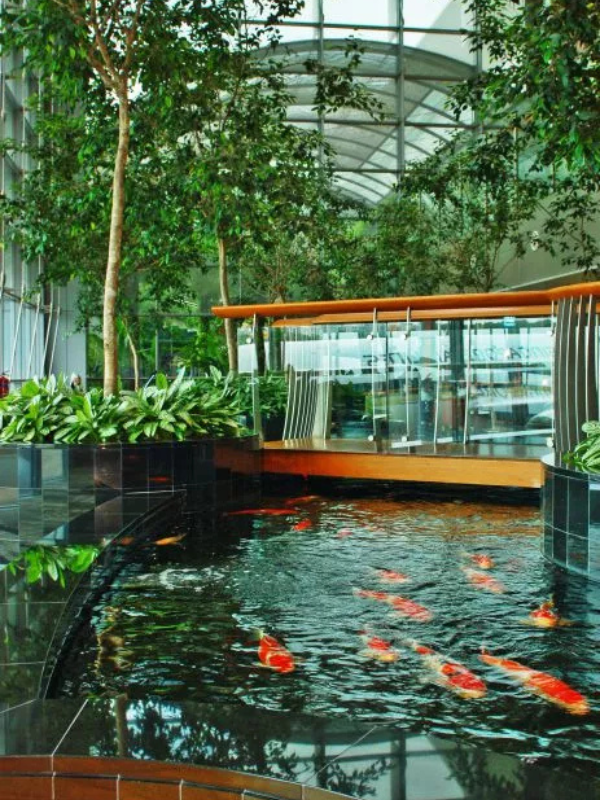
The ORCHARD indoor garden at Hamad International Airport covers approximately 6,000 square meters and contains 300 trees and 25,000 plants. Water-sensitive cooling systems soften the atmosphere of one of the world’s busiest transit hubs, making it feel closer to a managed landscape than a purely mechanical space.
Water Infrastructure Is Becoming Public Identity
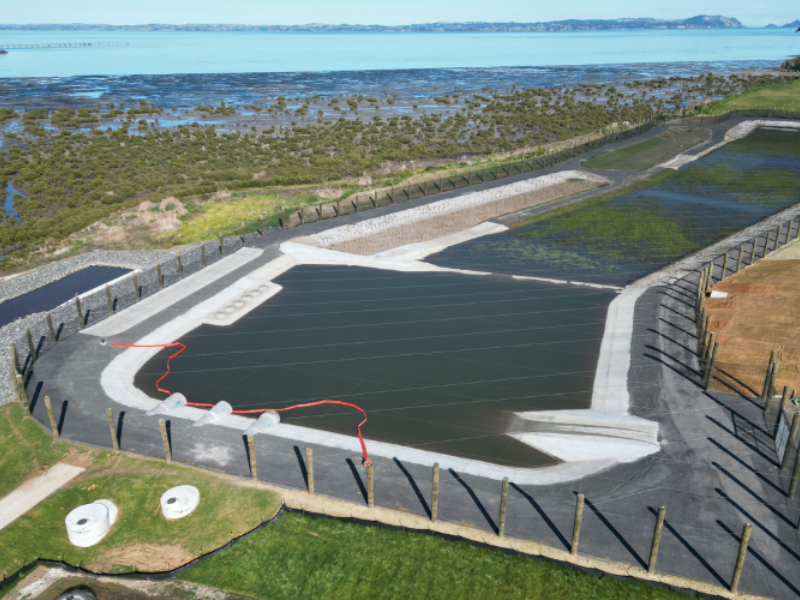
Courtesy of Auckland Airport
The increasing emphasis on water is much more than aesthetic. Airports are increasingly exposed to flooding, stormwater pressure, drought, and coastal climate risk.
This positioning is now evident at Auckland Airport through the development of its infrastructure. In response to the severe flooding that occurred in 2023, Auckland Airport began upgrading its stormwater systems. These improvements include building 4.4 km of stormwater pipe, enlarging retention ponds, and creating New Zealand’s first Coupled Wetland Biofilter on the boundary of the Manukau Harbor. The biofilters will treat more than 100 hectares of runoff across an 18,000-sq m site. This example illustrates the changing position of airports in relation to climate pressure and water management. Rather than defining itself solely through aviation growth, Auckland Airport is positioning itself as part of a larger coastal ecosystem shaped by harbor health and climate resilience.
A change can also be noted at Christchurch Airport, where protection of groundwater and aquifers has become one of the main priorities in sustainability. At the same time, Christchurch Airport has undertaken renewable energy initiatives, such as the Kowhai Park solar project, which can produce approximately 290 GWh per year.
The Rise of Water-Positive Airports
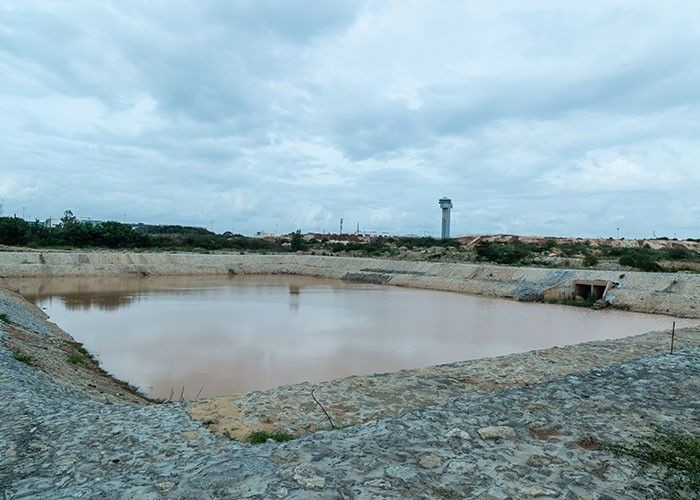
Courtesy of Bangalore International Airport Limited (BIAL)
Other airports have gone even further by ensuring that water conservation is central to their sustainability success stories. For instance, Indira Gandhi International Airport is the first of its kind in India to attain water-positive status, and its emphasis on water conservation plays an integral part in its sustainability strategy. Currently, the airport has established a sewage treatment plant that treats 16.6 Million Liters per day, with tertiary treatment and membrane filtration technology for reuse in air-conditioning cooling, flushing, and other airport purposes. To complement this, the airport has installed 746 rainwater-harvesting pits and smart water meters to conserve water.
While Kempegowda International Airport included hundreds of recharge wells and rainwater harvesting systems in its overall water-positive plan, the airport has also created over 315 recharge pits to redirect rainwater to the groundwater system and to reuse rooftop-collected water to irrigate plants and support HVAC processes. Rainwater harvesting and recharge systems were once invisible elements of airport engineering, but today they have become visible manifestations of the environmentally responsible approach adopted by airports.
In aviation, sustainability is shifting from abstract climate messaging toward visible systems passengers can directly experience, such as wetlands near the airport, water-recycling systems, tropical interior gardens, and stormwater landscapes.
Airports Are Preparing for a Wetter Future
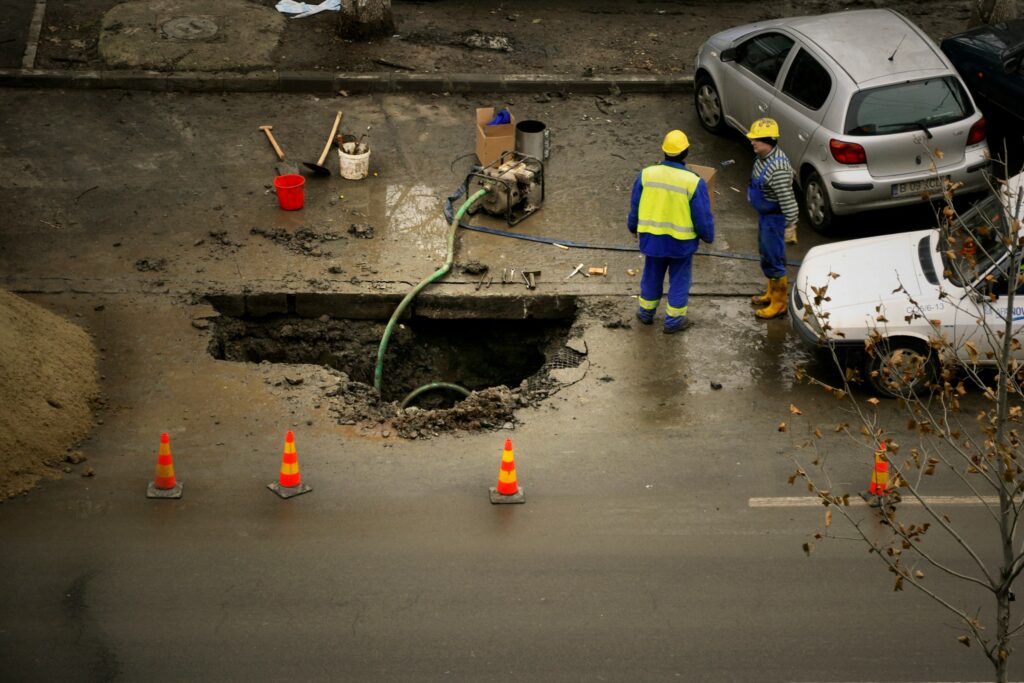
The aviation sector is moving towards an era where climate change adaptation could be as significant as growth.
In the International Civil Aviation Organization, stormwater management, flood resilience, and water infrastructure that responds to climate change have become key priorities for operating airports worldwide. As the number of passengers continues to grow, airports are not only adapting to intense rainfall and flooding but also pursuing more sustainable development.
Long-term planning is well underway already. Continuing its strategies towards sustainable development, Singapore Changi Airport has further strengthened its climate resilience mechanisms in light of rising sea levels and rainfall. In particular, drainage capabilities have been enhanced, flood barriers have been erected, and grooves have been created on all three runways to minimize the risk of aquaplaning. The airport has also adopted innovative runway-monitoring technologies that detect changes in climatic conditions.
The development of drainage networks connected to the airport in Dubai has also gained momentum in the wake of heavy rains in 2024 that paralyzed parts of the city, leading to a significant drop in capacity at Dubai International Airport. As a result, Dubai has invested 30 billion dirhams ($8.2 billion) in developing drainage networks to cope with the effects of climate change.
Meanwhile, Auckland Airport in New Zealand is developing nature-based stormwater systems, such as New Zealand’s first Coupled Wetland Biofilter, as part of its planning strategy through 2047. Auckland Airport’s future development plan focuses on linking aviation development with harbor protection, flood resilience, and ecological infrastructure.
A Different Future for Aviation Spaces
For travelers, the transformation may register gradually at first. Terminals will be quieter, more environmentally friendly, and more integrated with their surrounding landscapes. Landscaped water systems may increasingly replace hard, purely utilitarian terminal environments. Wetlands will be next to runways and transit ways. Water management systems, recycling systems, and adaptive landscapes will become part of the terminal experience rather than hidden infrastructures.
Airports could well start their transformation from mere transportation sites to carefully managed natural landscapes.
Such a change might very well prove to be the hallmark of future aviation architecture. With increasing stress on climate issues and rising numbers of travelers approaching the predicted total in the coming years, airports might come to be measured by how well they manage natural risks rather than by how efficient or large they happen to be. Future airports may still be measured by scale and efficiency, but the most influential ones could be defined by how carefully they operate within the landscapes they occupy.
Read More on: