
There was a time when getting clean meant leaving home.
You carried a towel down the street. You crossed paths with neighbors. You waited your turn. You stepped into heat, steam and conversation. Bathing was ordinary, necessary and, almost by accident, social.
Then the bathroom moved indoors.
Private plumbing transformed urban life for the better. It improved hygiene, comfort and dignity, and removed the need to organize a day around access to hot water. Yet as bathrooms entered individual homes, another kind of room began disappearing from cities: the public bathhouse.
Today, the surviving sento of Tokyo, municipal baths of Paris, neighborhood saunas of Finland and bathhouses supported by Seoul tell a more complicated story. Public bathhouses are no longer simply places to wash. In some cities they have become heritage. In others, welfare infrastructure. Elsewhere, they are being rediscovered by generations who already have perfectly good showers at home.
Their persistence raises an intriguing question: when a city stops bathing together, what exactly does it lose?
When Water Moved Behind the Front Door
The decline of public bathhouses is often presented as a straightforward story of progress.
In Japan, the transition is particularly visible in official statistics. According to the Ministry of Health, Labor and Welfare, ordinary public bathhouses accounted for 87% of public-bath establishments in 1970, compared with 12% in FY2023. As household bathrooms became widespread, traditional neighborhood baths steadily lost their practical necessity.
Tokyo followed the same trajectory. The city’s sento flourished when many households lacked private baths. Once bathrooms became standard in homes and apartments, attendance fell, and bathhouses began closing.
By the end of December 2024, only 430 public bathhouses remained across Tokyo, down from a post-war peak of 2,687 in 1968, according to Tokyo Metropolitan Government data.
What disappeared was not simply an inefficient way of washing.
A sento required people to leave home and enter a shared space. Neighbors, local shopkeepers, families and familiar faces could find themselves bathing under the same roof. These encounters did not need to be arranged; they were simply part of everyday life. In that sense, the sento provided more than hot water: regular, informal contact among people who shared a neighborhood.
Public bathhouses created contact through repetition rather than invitation.
The bathroom at home does the opposite exceptionally well. It offers control, solitude, and privacy.
The question is whether cities noticed what else moved indoors with the bathwater.
Tokyo’s Remaining Sento Are No Longer About Needing a Bath
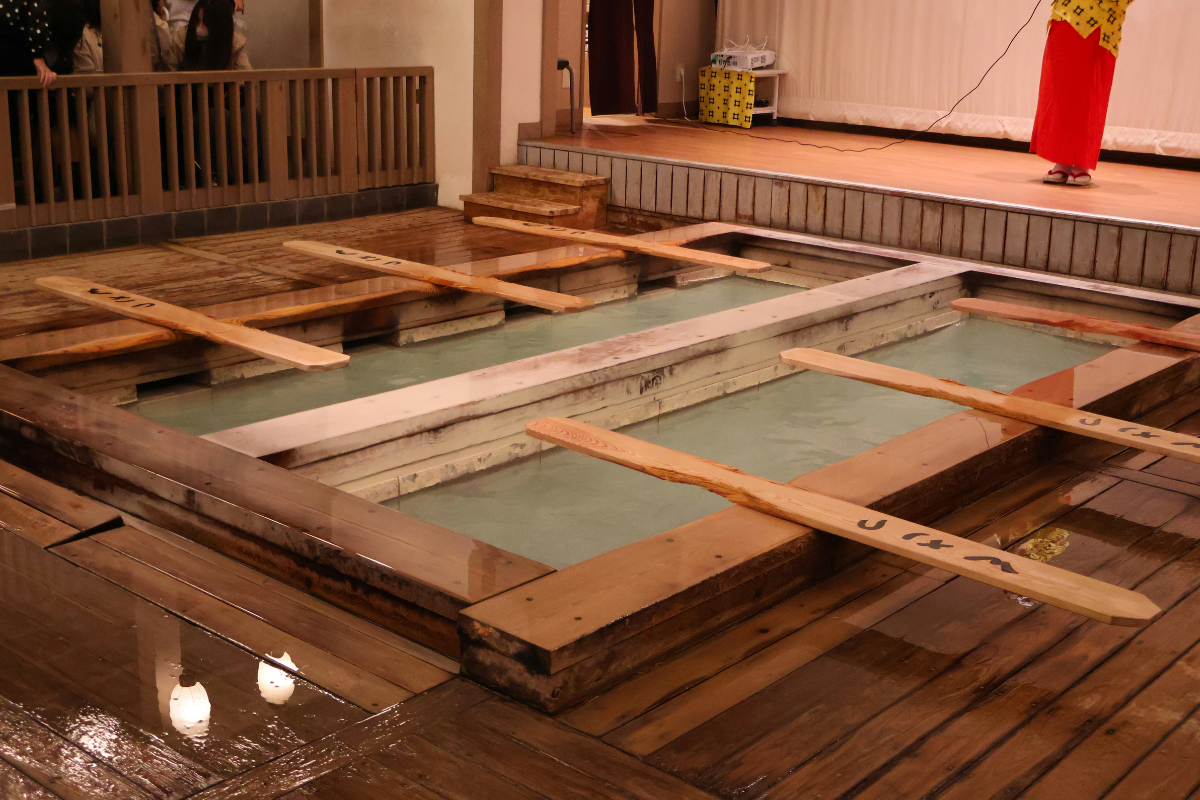
Tokyo’s surviving sento offer one answer.
The Tokyo Metropolitan Government notes that public baths in Japan stretch back more than a millennium, while neighborhood sento became embedded in daily urban life during the Edo period. In densely built Edo, fire risk even restricted the heating of bathwater in private homes, strengthening the role of communal baths.
That practical necessity has largely vanished.
Yet some sento are attracting new audiences, particularly younger visitors drawn by saunas and contemporary bathing culture. At the same time, some older bathhouses are being reimagined with contemporary interiors, cafés, bars and other additions that give people new reasons to step inside.
The appeal has changed.
People who can shower alone are choosing to bathe together.
That distinction matters. A public bathhouse that survives only because residents lack plumbing performs one urban function. A bathhouse chosen by people who have private bathrooms performs another.
The first supplies water and hygiene. The second supplies an experience the private home cannot reproduce quite so easily: being alone in the presence of other people.
Seoul Shows What Happens When the Bathhouse Still Matters
In Seoul, public bathhouses have never become purely nostalgic.
A city program launched in 2023 provides bathhouse access to residents of jjokbang – extremely small, low-quality rooms where adequate washing facilities can be limited.
Before the programme began, only 27.6% of jjokbang buildings had shower rooms, according to the Seoul Metropolitan Government. In a survey of residents, 18.1% identified the lack of shower facilities as the most inconvenient aspect of daily life.
Over three years, Seoul’s public bathhouse program recorded 90,835 uses, while reported satisfaction reached 97.3% in 2025, according to the Seoul Metropolitan Government.
Those numbers alone make the case that access to bathing remains an urban equity issue.
But Seoul’s program has begun to do more than just provide showers.
According to the city, the proportion of surveyed single-person households reporting bathhouse use rose from 71.6% in 2023 to 82% in 2025. The city describes participating bathhouses as neighborhood gathering places that encourage communication and help reduce loneliness among residents.
Then their function expanded again.
Some participating public bathhouses now operate as overnight shelters during periods of severe heat and cold. Four bathhouses accommodated 2,490 uses over 60 days during the winter of 2023. The following year, five locations recorded 5,189 overnight stays over 90 days.
A building designed around hot water has become, simultaneously, hygiene infrastructure, social infrastructure and climate infrastructure.
That evolution may be more important than preserving the bathhouse exactly as it once was.
Paris Never Entirely Closed the Door
Paris offers another version of survival.
Its municipal bains-douches were built for an era when many residents did not have bathrooms at home. Housing standards improved, and the original reason for maintaining a large public-bathing network diminished.
Yet the city did not eliminate it entirely.
Paris still operates municipal bathing facilities where people can use individual showers free of charge. In a 2022 press release, it was reported that there were approximately 550,000 showers a year across its 17 municipal bathhouses.
Half a million showers in one of Europe’s wealthiest capitals is difficult to dismiss as a historical curiosity.
The reason for public bathing has simply shifted.
For many contemporary users, the municipal bathhouse is no longer an ordinary household substitute. It is part of the city’s response to homelessness, poverty, and inadequate access to sanitation.
That transition exposes something easily hidden by the architecture of affluent cities.
Indoor plumbing may be widespread, but access to it is not universal.
A private bathroom is a domestic amenity only if someone has a secure private home.
The last public bathhouses therefore occupy an unusual position. They are remnants of an earlier urban system, yet they continue to solve very contemporary problems.
Finland Nearly Lost Its Public Sauna. Then People Wanted It Back.
If Seoul and Paris demonstrate continuing need, Finland offers something different: desire.
Sauna culture remains deeply embedded in Finnish life. UNESCO, which inscribed Finnish sauna culture on its Representative List of the Intangible Cultural Heritage of Humanity in 2020, records approximately 3.3 million saunas for a population of 5.5 million.
That abundance could make the public sauna unnecessary.
For a while, it almost did.
UNESCO notes that traditional public saunas in Finnish cities nearly disappeared after the 1950s. More recently, however, new public saunas have appeared through private initiatives.
Here again, private access did not eliminate the attraction of shared bathing.
It changed what the shared bath was for.
A sauna at home provides heat. A public sauna offers heat, strangers, architecture, ritual, a journey through the city, and the possibility of an unplanned encounter.
This may help explain why contemporary public bathhouses are increasingly being reconsidered not as outdated sanitation infrastructure but as places of urban culture.
They ask very little of their users.
You do not need a dinner reservation. You do not need to belong to a club. You do not necessarily need to arrive with friends.
You simply arrive.
The Most Intimate Form of Public Space
Cities spend considerable effort designing places where people can gather: plazas, parks, libraries, markets and cultural centers.
The public bathhouse is stranger.
It is public space built around one of the most private things the body does.
That contradiction may be part of its social power.
Clothing, occupation, and many visual signals of status become less useful in water and steam. The bathhouse cannot erase class, age or social difference, but historically it has brought people into unusual physical proximity across those divisions.
Its architecture encourages a form of coexistence that increasingly requires deliberate effort elsewhere.
Many contemporary spaces allow people to be together while remaining socially separate. Headphones, screens, cars, deliveries and private apartments make everyday life extraordinarily efficient without requiring much interaction.
Efficiency is not inherently the problem.
But cities depend on more than intimate friendships. They also depend on weak ties: recognizing a face, exchanging a few words, noticing when somebody has not appeared for a while.
The public bathhouse once produced those relationships almost incidentally.
A Lonelier City Does Not Prove the Bathhouse Was the Answer
There is a temptation to romanticize all of this.
Public bathhouses were not universally inclusive or idyllic. They could reflect class divisions, gender rules, discrimination, and uneven standards of cleanliness. Private bathrooms represented enormous gains in health, autonomy and dignity.
Nor can the disappearance of communal bathing be blamed for contemporary loneliness.
The evidence does not support that conclusion.
What we can say is that the context has changed dramatically.
In 2025, the World Health Organization reported that approximately one in six people globally experiences loneliness. Its Commission on Social Connection also estimated that loneliness is associated with more than 871,000 deaths annually, or roughly 100 every hour.
WHO describes social disconnection as a significant public-health challenge and calls for environments and policies that strengthen social connection.
Against that backdrop, the disappearance of ordinary communal spaces deserves another look.
Not because cities should force people back into bathhouses.
Because the bathhouse demonstrates something urban planning sometimes forgets: useful infrastructure can also create relationships.
A place can solve a practical problem while creating opportunities for regular, informal social contact.
What the Last Bathhouses Are Becoming
Perhaps the most interesting public bathhouses are not those preserved exactly as they were, but those that change without losing the principle underlying them.
In Seoul, they offer showers and refuge during extreme weather. In Paris, they preserve access to basic hygiene for people excluded from private bathrooms. In Tokyo, some are finding new audiences through saunas, food, design and culture. And in Finland, public sauna culture is reappearing despite the extraordinary availability of private saunas.
These are very different models, yet they point towards a shared idea: the future of communal bathing may depend less on preserving the bathhouse as an artifact than on understanding what made it useful.
The private bathroom solved a great many problems. It brought hot water, privacy, convenience and control into the home. Few people would willingly exchange that for the sanitation conditions of an earlier city. But progress does not always replace one thing with an equivalent. Sometimes it solves a problem while quietly removing a social ritual in the process.
That may be the lasting significance of the world’s remaining public bathhouses. They remind us of a city organized differently around water – one in which washing, warmth, and other people occupied the same room.
Water was the reason people arrived. The city happened around it.
The question is not whether everyone should start bathing together again. It is whether cities still know how to create places where people can share something ordinary.
Read More On: