
Across the desert of southwestern Algeria, water and food are anything but ordinary resources. For Sahrawis living in refugee camps far from the sea, even accessing fresh fish can involve extraordinary distances and difficult journeys. Yet among the sand and extreme heat, an unexpected form of food production has emerged: tilapia raised in artificial ponds.
Photojournalist Gianni Esposito’s images capture this unusual meeting of water, food and desert. His photographs move through a landscape that initially appears almost incapable of supporting such production, only to reveal ponds filled with fish and the people working around them.
The contrast is difficult to ignore. Fish – a food so instinctively associated with oceans, rivers and lakes – is being raised in the middle of an intensely arid landscape.
Far From the Sea
For Sahrawis living in refugee camps in the desert of southwestern Algeria, access to fish is a constant challenge. Far from the sea and surrounded by an extremely arid landscape, producing fresh food locally requires solutions adapted to conditions where heat and water scarcity shape everyday life.
Fish also carries meaning beyond nutrition. Esposito’s story connects it with memory and identity, giving the presence of tilapia in the desert another dimension. Against this backdrop, the N’khaila aquaculture project represents an unexpected approach to local food production: raising fish in artificial ponds within the camps themselves.
Instead of presenting the desert solely as a barrier to food production, Esposito’s photographs reveal a landscape where people find ways to work within difficult conditions. Here, fish becomes not simply a food associated with the sea, but part of a wider story of survival, adaptation and resilience.
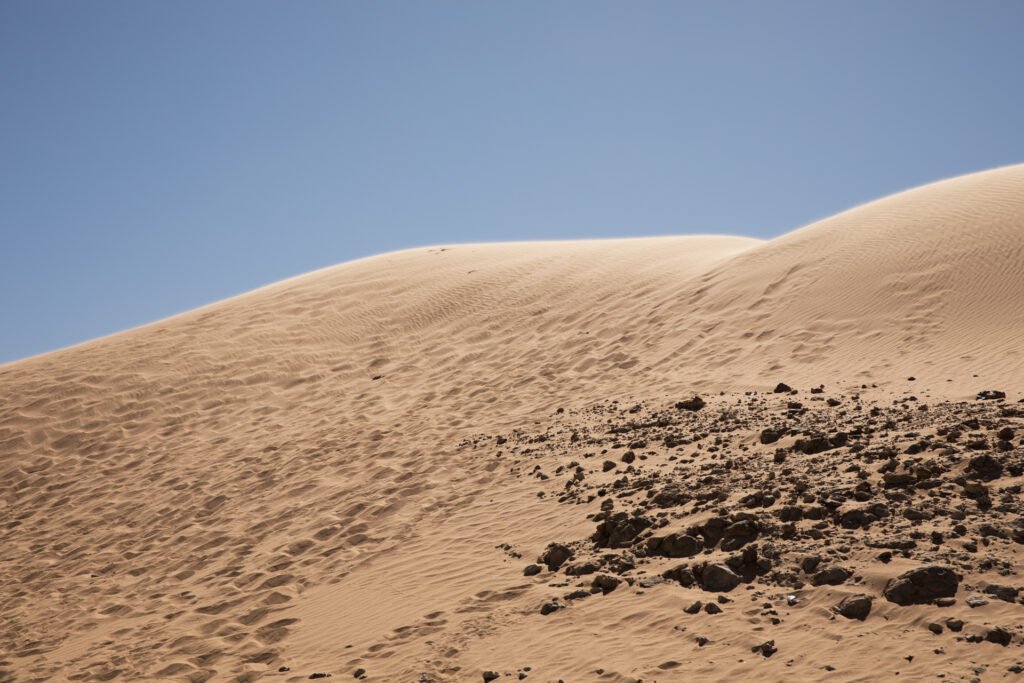
The stark desert landscape surrounding the Sahrawi refugee camps, where food and water scarcity shape everyday life. Photo courtesy of Gianni Esposito.
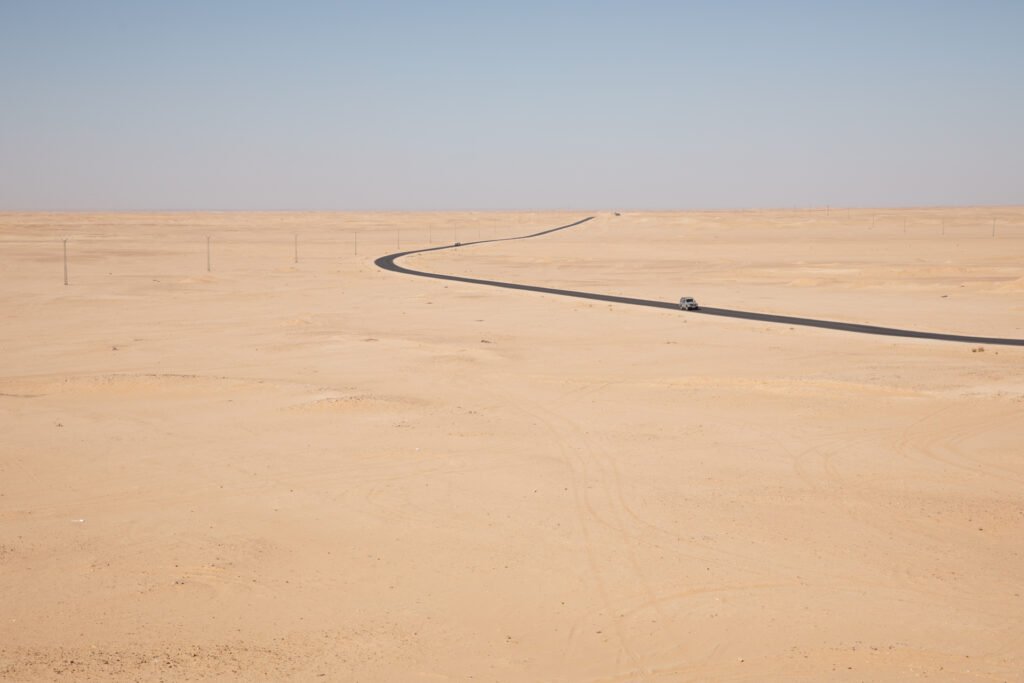
A road stretches across the vast desert landscape surrounding the Sahrawi refugee camps, highlighting the isolation of life in this arid region. Photo courtesy of Gianni Esposito.
An Unexpected Landscape for Food Production
As Esposito’s photographs move closer to N’khaila, the landscape begins to change. Against the surrounding sand, the fish farm appears alongside palms, vegetation, and modest infrastructure, creating a striking contrast with the open desert seen earlier in the story.
This setting makes the idea of raising fish here all the more remarkable. In an environment where temperatures can exceed 50°C, artificial ponds enable aquatic food production where it might otherwise seem unlikely.
The photographs do not attempt to explain the technical workings of the system. Instead, they show how the farm exists within its surroundings. Buildings sit on sandy ground, vegetation grows around the site, and people move through the landscape as part of its everyday activity.
It is this contrast that gives N’khaila much of its visual power: a working space for food production taking shape within one of the most challenging environments in which to imagine such a space.
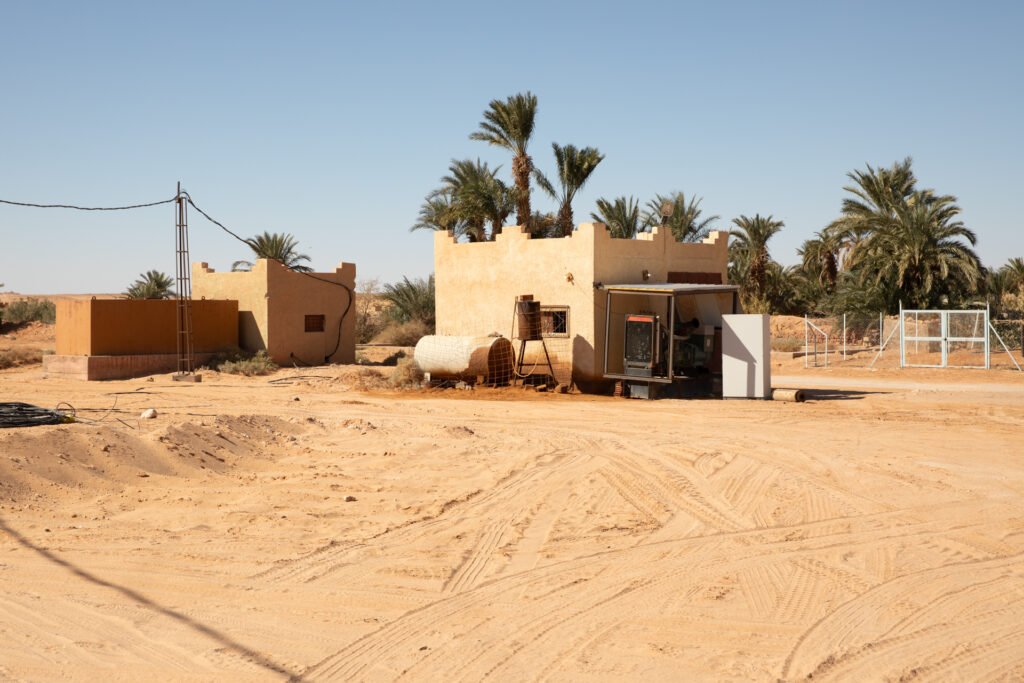
The N’khaila fish farm sits within the arid desert landscape of the Sahrawi refugee camps in southwestern Algeria. Photo courtesy of Gianni Esposito.
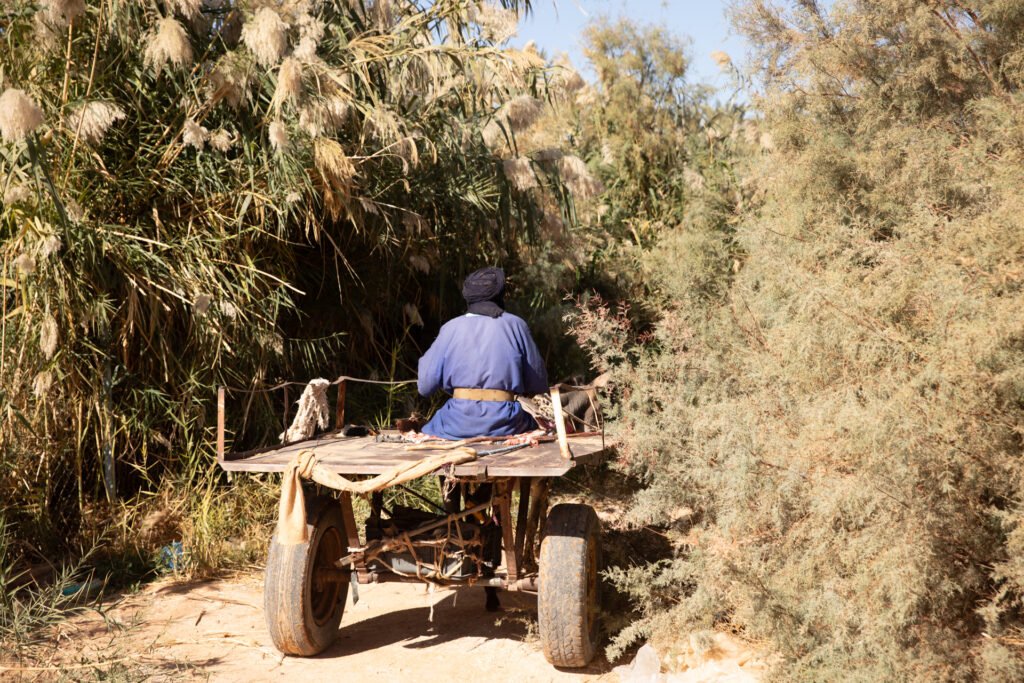
A worker travels through the vegetation surrounding the N’khaila fish farm, revealing another side of its desert setting. Photo courtesy of Gianni Esposito.
Tilapia in an Unlikely Home
Then the fish appear.
Esposito’s photographs bring the viewer close to dense groups of tilapia underwater and into moments when the fish are being handled. The desert temporarily disappears from the frame, replaced by movement, water, nets and living animals.
The project raises Nile tilapia and red tilapia, species selected for their ability to withstand high temperatures. Here, fish becomes something more than a product arriving from elsewhere. It is being produced within the camps themselves.
That changes the meaning of the landscape.
The artificial ponds turn a place defined by scarcity into an experimental space for local food production. The fish are therefore not simply the subject of the photographs. They represent an attempt to adapt food production to circumstances that leave few conventional options.
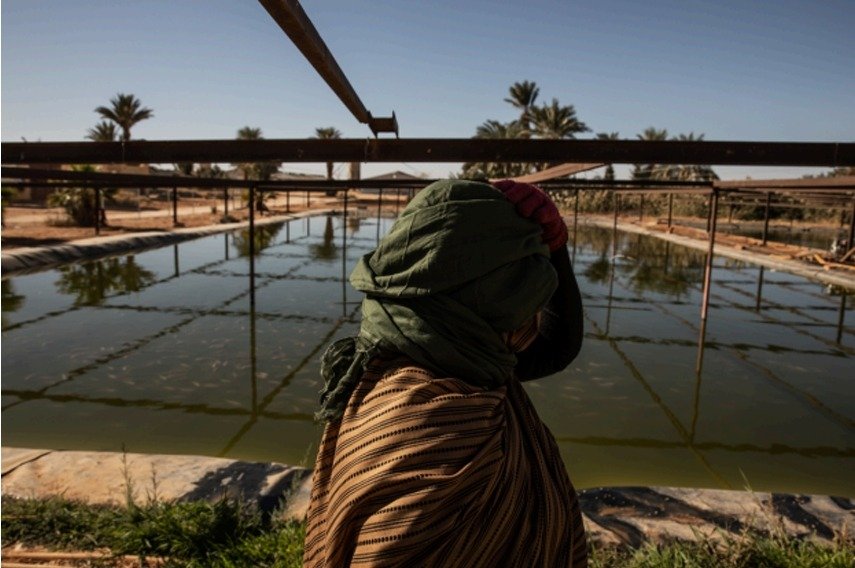
A worker stands beside the tilapia ponds, reflecting the human effort behind fish production in the arid Sahrawi refugee camps. Photo courtesy of Gianni Esposito.
Water, Fish and Adaptation
Moving deeper into N’khaila, water becomes an increasingly visible part of the landscape. A water tanker appears against the vast desert surroundings, while at the farm, pipes and hoses run alongside artificial ponds where tilapia gather beneath the surface. Palms and vegetation grow around the water, creating a striking shift from the dry expanses that open the photo story.
In this setting, water connects landscape directly with food production. The ponds create an aquatic space within an overwhelmingly arid environment, allowing tilapia farming to become part of a place where such a sight initially seems almost unimaginable.
Esposito’s photographs capture this contrast from different perspectives. Wide views reveal ponds bordered by sand and vegetation, while closer images draw attention to the fish moving through the water and the infrastructure surrounding them. Together, they show how water, people, and the physical environment converge around food production.
What emerges is not simply the unusual sight of fish being raised in the desert, but a broader picture of adaptation. At N’khaila, water becomes the link between an unforgiving landscape and a locally produced food source – turning what first appears to be a contradiction into part of everyday life.
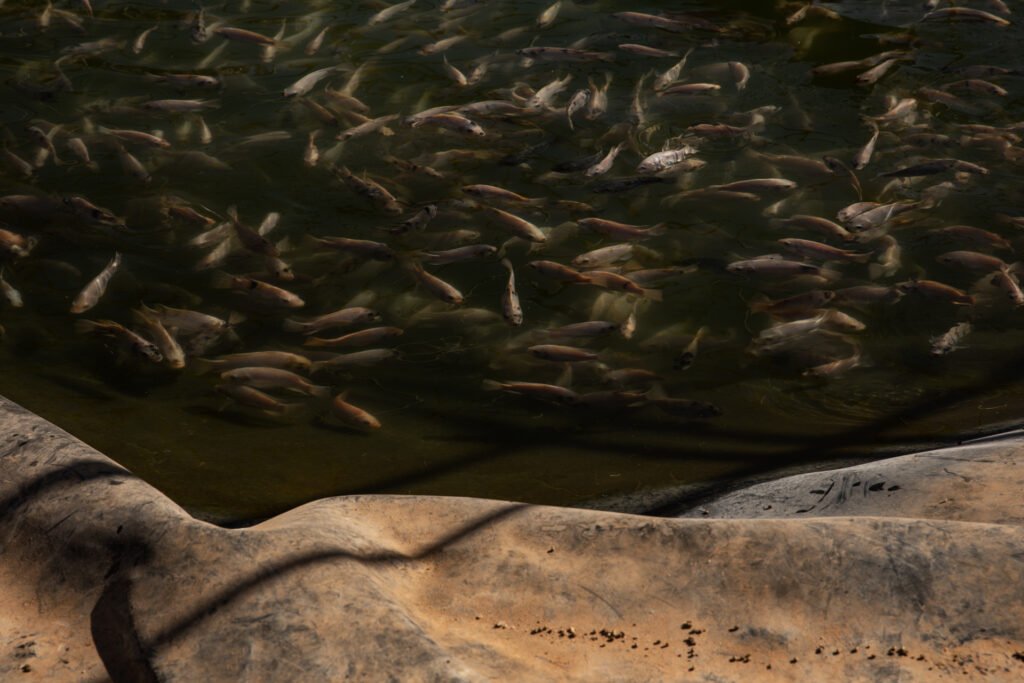
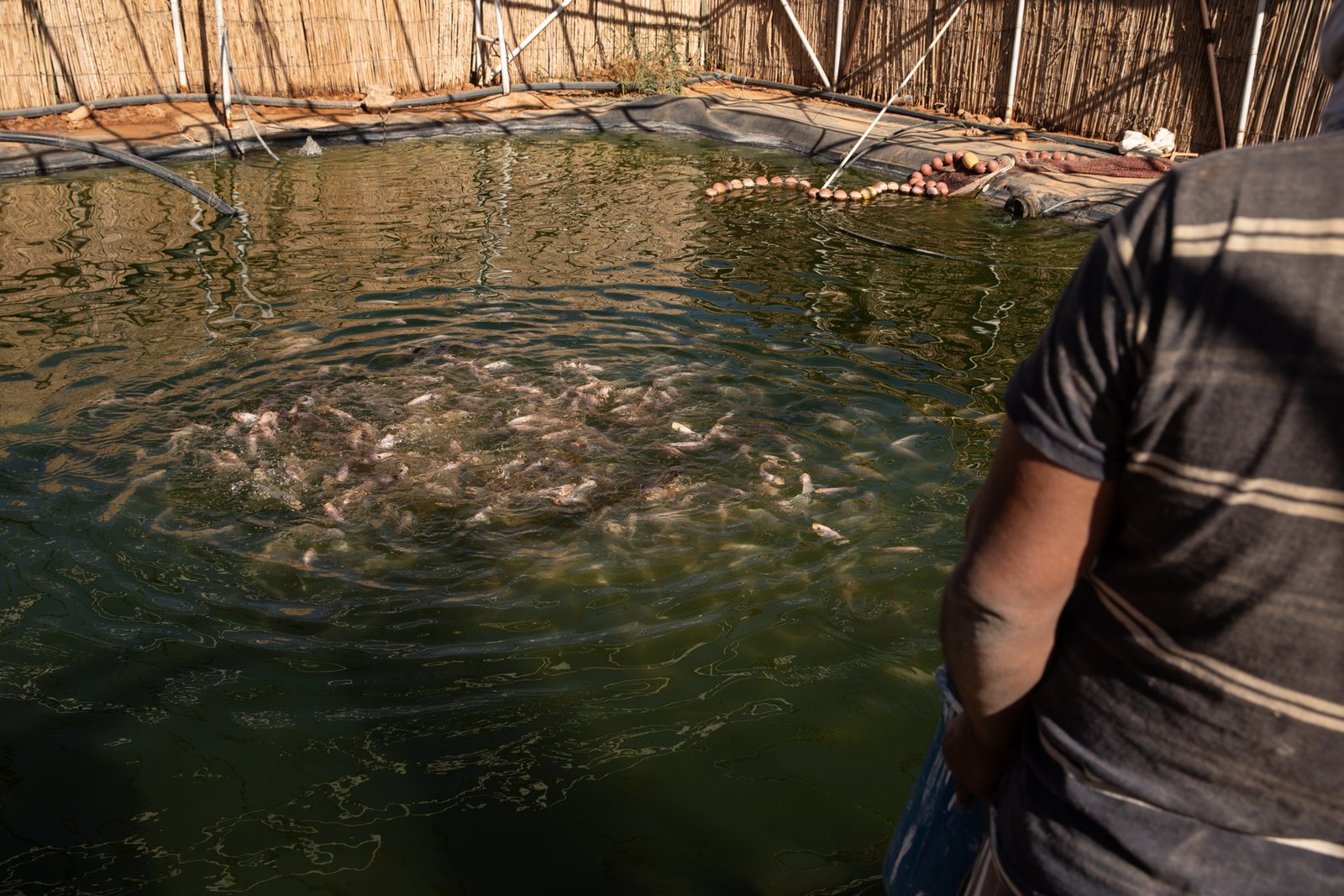
Tilapia gather beneath the surface of an artificial pond at the N’khaila fish farm, bringing aquatic food production into the heart of the desert. Photo courtesy of Gianni Esposito.
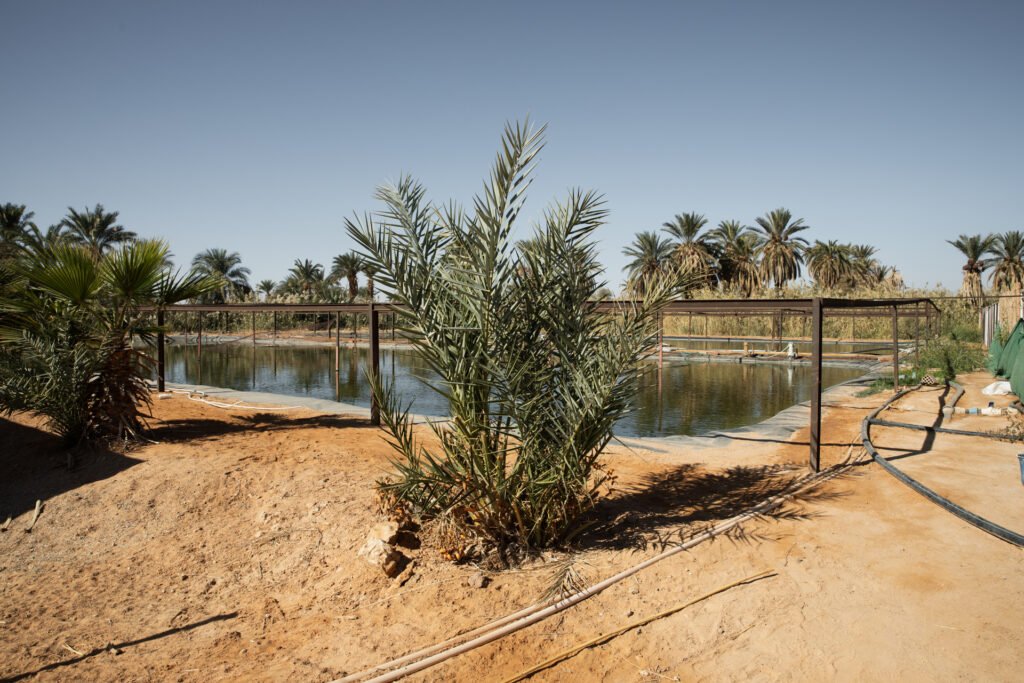
Artificial ponds, surrounded by palms and connected by visible hoses and pipes, reveal the water infrastructure supporting tilapia farming at N’khaila. Photo courtesy of Gianni Esposito.
Tilapia in the Desert
The project raises Nile tilapia and red tilapia, species known for their resistance to high temperatures. In Esposito’s photographs, the fish gather beneath the water, break the surface of the ponds, and are eventually seen collected in a net, held by several hands.
These closer images bring N’khaila’s purpose into view. What began as a story told through desert landscapes is now unmistakably about producing fish in a place far removed from the sea.
Around the ponds, people become part of the scene – watching the water, tending to the fish, and gathering them by hand. What first seems remarkable in the vast Saharan landscape is, at N’khaila, part of the daily work of desert food production.
For Sahrawis living far from the sea, producing fish locally carries meaning beyond meeting an everyday food need. Fish is also tied to memory and identity, and raising tilapia within the camps offers a way to keep that connection alive, even in the desert’s vastly different landscape.
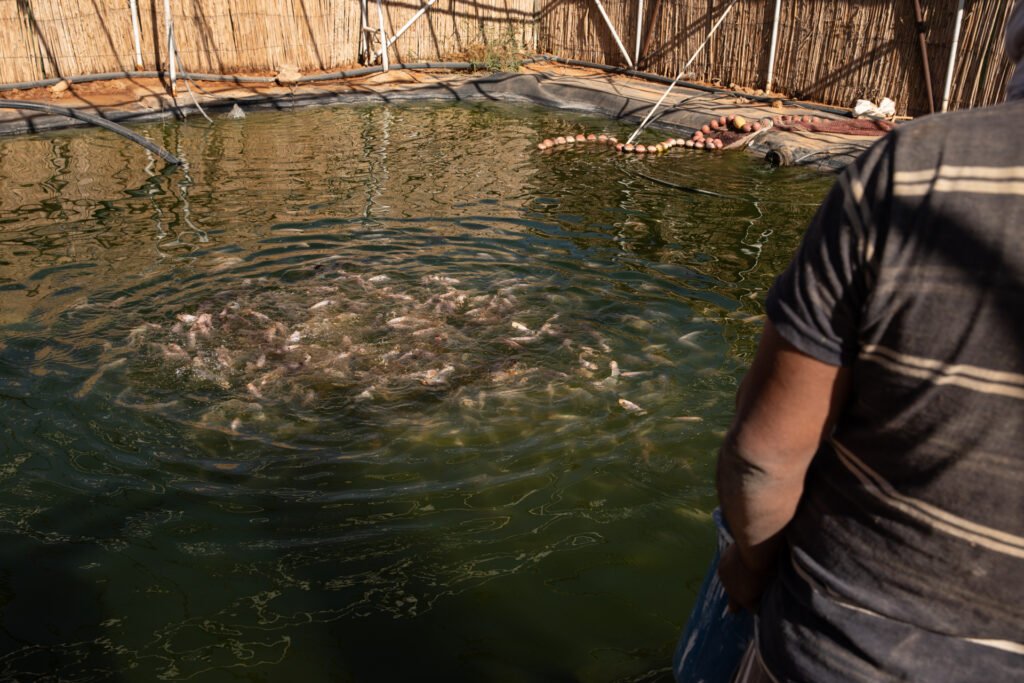
Tilapia gather at the surface of a pond as a worker looks on at N’khaila fish farm. Photo courtesy of Gianni Esposito.
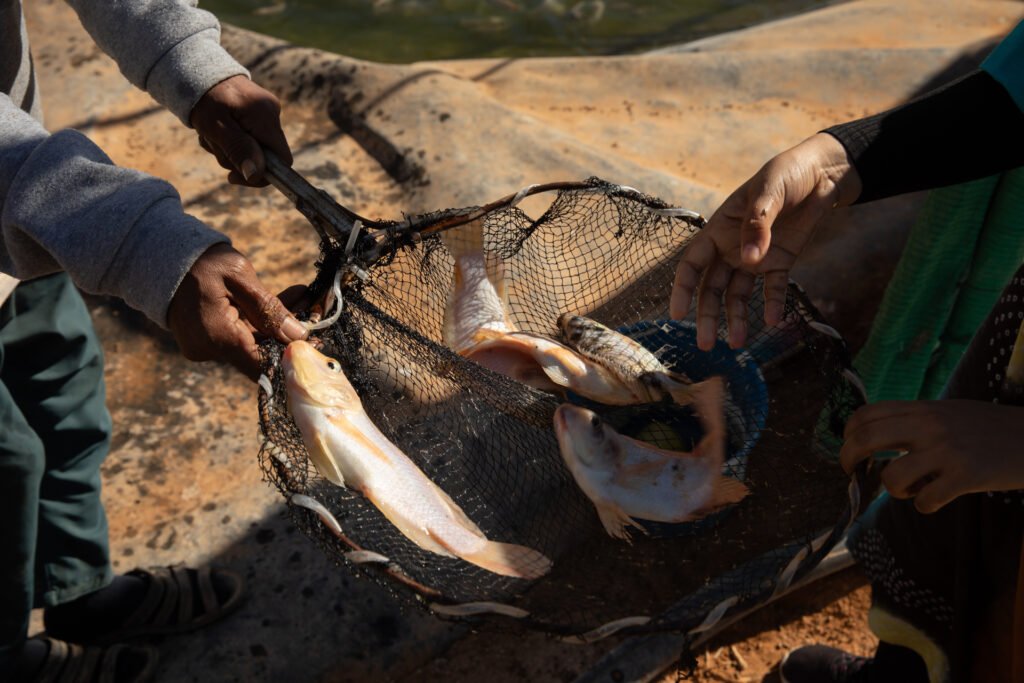
Freshly collected tilapia are held in a net at N’khaila fish farm, bringing the desert aquaculture story from pond to catch. Photo courtesy of Gianni Esposito.
The People Behind the Ponds
After bringing us close to the fish, Esposito takes the story indoors.
The outdoor ponds give way to a quieter space lined with rectangular tanks, pipes, and water. Jadija, a biology technician, moves through the facility, looking into the tanks and standing between them. The change in setting shifts attention away from the unusual spectacle of fish in the desert and towards the people connected to their production.
This is an important turn in the photo story.
N’khaila is not only about ponds, fish, or infrastructure. It is also about human involvement – people working within the limits of their environment and participating in a different way of producing food.
The project initially began with support from the World Food Program, but today it operates with very limited resources and no current funding. The eleven people involved in the project continue their work on a voluntary basis, keeping the fish farm running despite these constraints.
Esposito’s portraits make that relationship feel personal. Rather than presenting adaptation as a general idea, his photographs place a person at its center. The tanks and water surround her, but she becomes the focus.
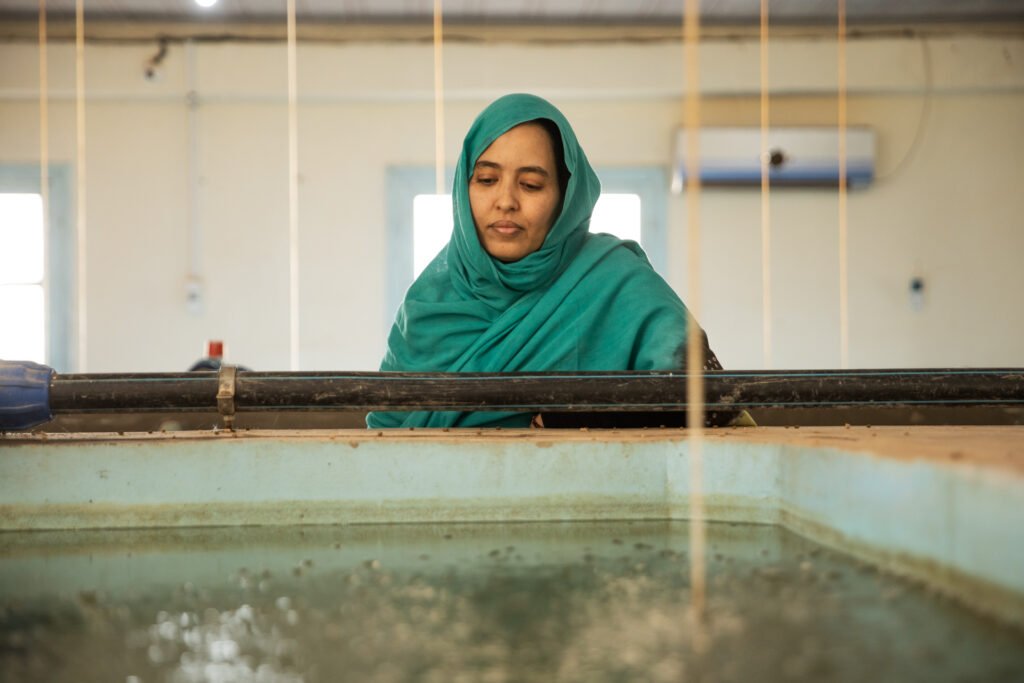
Jadija, a biology technician, tends to an indoor tilapia tank at N’khaila. Photo courtesy of Gianni Esposito.
More Than Fish in the Desert
Near the end of the series, Esposito returns to the tilapia once more. Seen from above, individual fish emerge from dark water, their bodies catching the light. The image feels markedly different from the barren desert that opened the story.
That visual journey – from sand to vegetation, ponds, fish and people – captures what makes N’khaila compelling.
The project does not remove the realities of living far from the sea, nor does it transform the harsh environment surrounding the Sahrawi refugee camps. Instead, it shows one way people are adapting food production to circumstances shaped by displacement and an extreme climate.
Esposito’s final human image takes us back outside. A figure emerges from the facility’s doorway into the desert light. The building, sand and harsh exterior return to the frame, reminding us where everything we have just seen is taking place.
It is a fitting conclusion to a story built on contrasts.
At N’khaila, fish remain connected to water, food and memory – but no longer only to the distant sea. Within artificial ponds in the desert, tilapia have become part of another story: one of survival, adaptation and resilience in a place of exile.
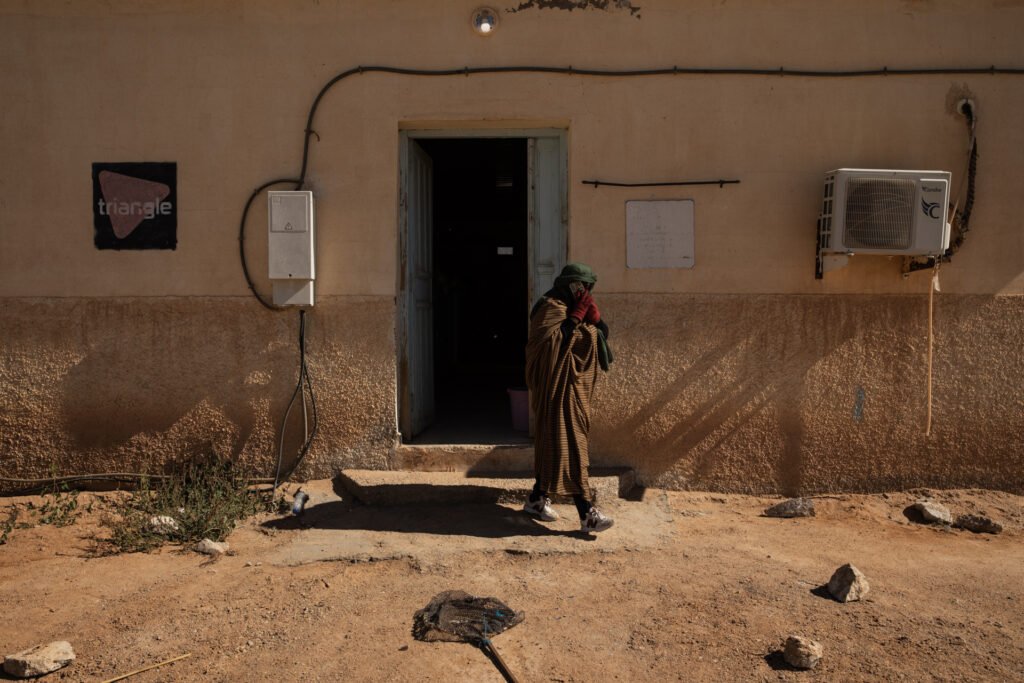
A worker steps outside the N’khaila fish farm, returning the story from the indoor aquaculture tanks to the surrounding desert landscape. Photo courtesy of Gianni Esposito.
This content is part of a project with the Comissió Catalana d’Ajuda al Refugiat (CCAR), through the DevReporter Connect for Global Change grant by Lafede.cat.
Read More On: