
Entering the Sea’s World
MEDUSA begins with an invitation: leave the shoreline behind.
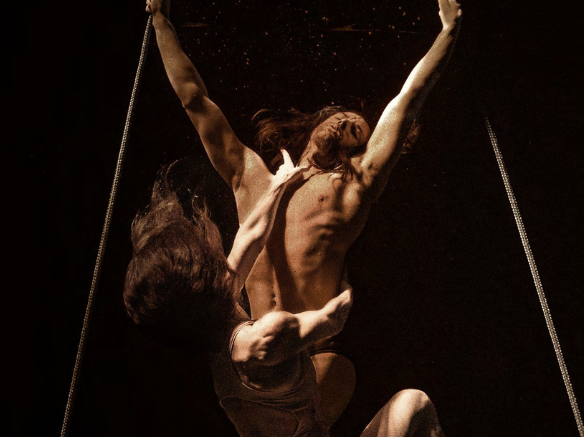
Underneath the waters of a pool five meters deep, five professional dancers delve into an underwater realm where the rules of silence, flotation, and breathing apply. For a period of 25 minutes, they execute an entire performance using the technique of breath holding. In total, they collectively build on over an hour and fifteen minutes of breath-holding performances.
MEDUSA uses underwater performance as a way to explore how people relate to the marine environment.
As an intersection between contemporary dance, aquatics, and visual poetry, this project is an attempt to restore a connection between the audience and something that gives life but is alienated from our daily lives. Through immersion and movement, the project asks whether direct experience can change how people understand the sea.
As journalist and Med Mosaic founder Mona Samari writes:
“To understand the sea, we must enter its world first.”
This is precisely what her statement portrays. Against a backdrop of warming seas, intensive fishing, and growing jellyfish populations in the Mediterranean, the title takes on ecological significance. The mythological Medusa turns into the ecological Medusa, embodying change, disequilibrium, and the changing relationship with the oceanic world.
Samari sees that marine journalism will inform, while performance art will translate what is unseen into something emotionally understandable. With an underwater narrative, MEDUSA offers a new means of connecting humans with the ocean.
Where Breath Becomes Choreography
It is not just the fact that MEDUSA is an underwater performance but rather that it happens exclusively via holding one’s breath.
All five performers lack experience in synchronized swimming. They have created their own underwater choreography, which has breath-holding as its basis and has been molded through resistance in water. In this space between surface and depth, movement slows down, expands, and mutates. Gravity works in a different way. Time seems stretched.
Thus, an aesthetic emerges out of movements based on the dynamics of water currents, waves, and changing forces. In such an environment, the bodies move in relationship to each other, connecting, separating, supporting, and even resisting.
The production is unusual in combining a 25-minute choreography, breath-hold performance, and a submerged setting without breathing assistance
However, despite this physical feat, MEDUSA never comes across as an example of endurance. Rather, breath becomes a tool of narration, illustrating fragility, resilience, surrender, and adaptability.
Water as a Partner
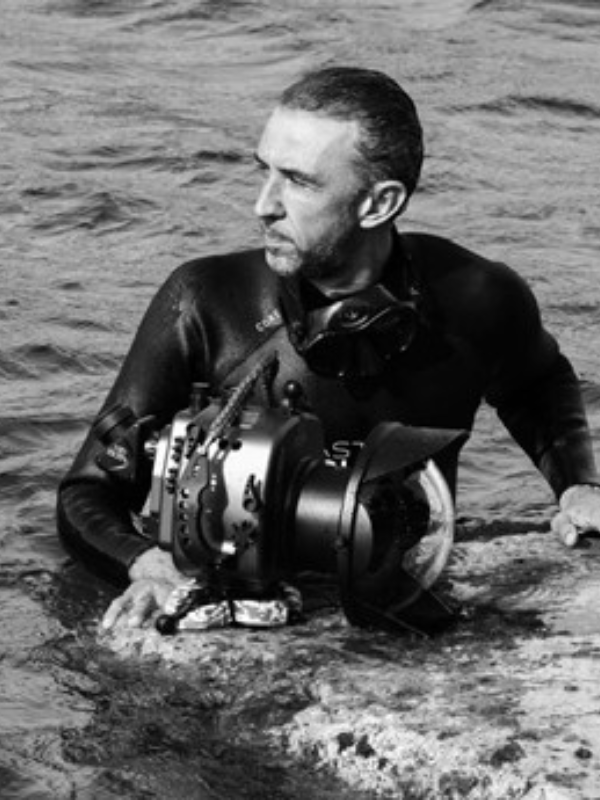
At the center of MEDUSA is the vision of its creator, Bastien Soleil.
Soleil’s practice combines freediving, dance, photography, and filmmaking. All of Soleil’s works of art come into existence in just one breath alone without any help up to a depth of twenty meters underwater.
His performances underwater are purposefully fleeting. Since they cannot be seen entirely, photography becomes their only form of documentation. The photos that result are done without using any sort of artificial intelligence or computer manipulation.
Soleil has been teaching professional dancers how to perform in conditions when breathing is suspended for many years. His artistic career has expanded to include cinema with his internationally recognized short movie called Tang’O in 2020, and now Tang’O 2 is being prepared.
MEDUSA marks another development in Soleil’s body of work where instead of recording his underwater performances, he engages the audience in them.
Soleil often returns to the idea that environmental stewardship begins with familiarity and emotional connection. The way that MEDUSA tries to bring about this transformation is by using the process of immersion.
An Artistic and Ecological Statement
MEDUSA works in an overlap of being art, science, education, and ecology at once.
Artistically, it merges dance, music, technology, lighting, and water into an engaging, modern-day story. Physically, it tests the limits of performance using breath-holding technique. The project also highlights the technical collaboration required to stage performance in an underwater environment.
Transmission is another key aspect in the project. The concepts of resilience, connections, and equilibrium pervade the entire piece and present an opportunity for knowledge and ecological understanding to be conveyed.
The environmental theme is very clear but does not come out bluntly. It does not provide scientific facts about the environment but instead lets the audience think about where we humans fit in the delicate network of relations that surrounds us. Rather than presenting scientific findings, the work uses performance to consider how humans coexist with marine ecosystems.
The Artistic Team Behind MEDUSA
The project unites a community of international artists who have varied experience in dance, freediving, movement therapy, performance, and visual narration.
Concept and Artistic Direction: Bastien Soleil
Choreography: Marion Crampe and Rose Molina Barrios
Performers: Marion Crampe, Rose Molina Barrios, Aurélie Coze, Dimitrii Staev, and Oliver Gregory
The production is presented by Le Premier Souffle, a French non-profit organization, with support from partners including Med Mosaic, Molchanovs, Mila Krasna, and Démêlé.
The Dancers of the Submerged Stage
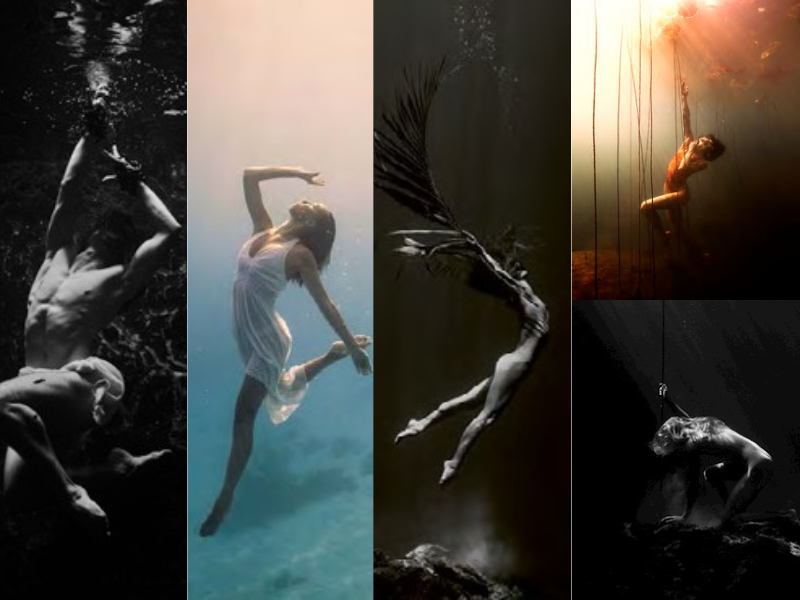
MEDUSA brings together performers whose backgrounds span contemporary dance, freediving, movement therapy, photography, and aquatic performance. Rather than approaching water as a stage, the ensemble treats it as a creative partner, adapting movement to buoyancy, resistance, and the constraints of breath-holding.
The cast includes choreographers Rose Molina Barrios and Marion Crampe alongside performers Aurélie Coze, Dimitrii Staev, and Oliver Gregory. Their varied practices contribute to a shared physical language shaped by immersion, suspension, and cooperation beneath the surface.
Together, they create a performance that depends less on individual virtuosity than on collective adaptation to the underwater environment.
The First Dive
The world premiere of MEDUSA had been set to take place on 30 May at 9:30 p.m. during the Dance Biennale festival in Les Sables-d’Olonne, France.
The concept of this piece of art revolved around dual audience participation.
A select group of spectators would enter the water behind a safety line and don masks and snorkels before being immersed in the same aquatic environment where the dancers performed.
However, the main audience would gather in the garden of the Palais de Justice, as the performance was scheduled to be relayed live by means of a projection.
The choreography would take place in the Remblai swimming pool, at depths not exceeding five meters. All the action would be recorded using only one camera set up on a tripod at the bottom of the pool, while the audio environment would be delivered simultaneously both above and below water.
The format reduces the distance between performer and audience, allowing spectators to share aspects of the same environment.
An International Artistic Ecosystem
Although MEDUSA begins underwater, its ambitions extend far beyond a single pool.
After its first performance, it is planned that the project goes on tour in various countries across different continents and cultures, presenting its aquatic language to new audiences. As a living piece, MEDUSA will keep growing through meetings with performers, dancers, and artists from various cultural and generational backgrounds.
The key to this vision is transmission. The performers of the future will learn how to live within the water element as naturally as they live within movement, thus enriching the artistic language of the project.
Eventually, MEDUSA wants to evolve from being a mere performance into becoming an artistic ecosystem that promotes awareness and instills ocean literacy, along with restoring reverence for the ocean realm, through the common medium of movement.
Entering the Sea’s World
Mona Samari writes that “to understand the sea, we must enter its world first.”
MEDUSA takes that idea literally.
The piece transcends normal limits set by the separation between humans and water through the use of breath-holding, movement suspension, and storytelling. The audience is taken past the point of being mere spectators to become participants.
At a time when marine issues are often discussed in terms of crisis and risk, MEDUSA approaches the ocean through immersion and observation. It prompts us to recognize that if we want to save the ocean, we first need to know how to meet it.
Not from the shoreline.
But from within its world.
Read More on: