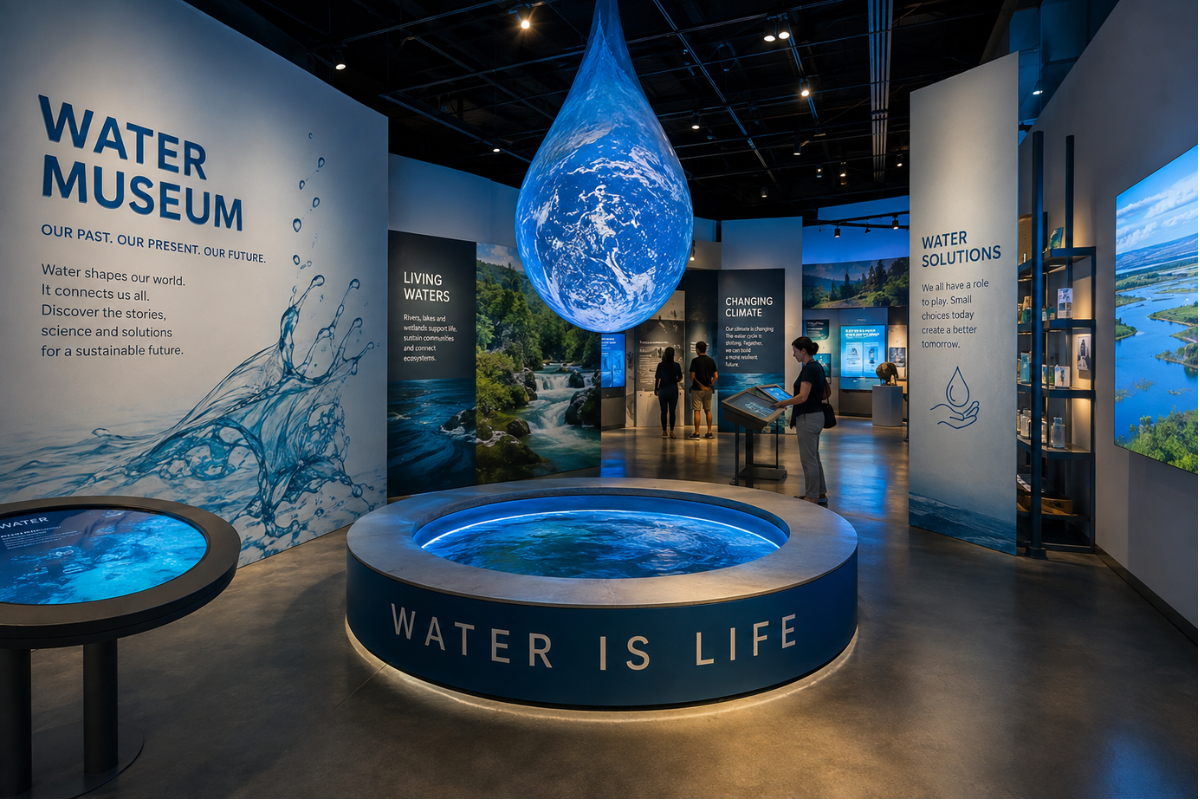

For generations, museums have helped us look backward. They preserve objects, memories and stories that might otherwise disappear. But what happens when the subject they are preserving is itself changing?
Water is becoming one of the clearest indicators of a changing climate. According to the World Meteorological Organization, 2024 was the hottest year in its 175-year observational record, with global surface temperatures reaching 1.55°C above pre-industrial levels. Across the water cycle, the consequences were striking: severe drought affected parts of South America and southern Africa, devastating floods hit regions of Africa, Europe and Asia, and glaciers continued to lose ice at record levels.
As rivers, lakes, reservoirs, groundwater and glaciers respond to a warming world, telling the story of water is becoming increasingly important.
Against this backdrop, a growing network of water museums is expanding its role. And rather than simply displaying the history of wells, waterways and hydraulic engineering, many are asking a more urgent question: how should we live with water in a changing climate?
When Water Museums Look Forward
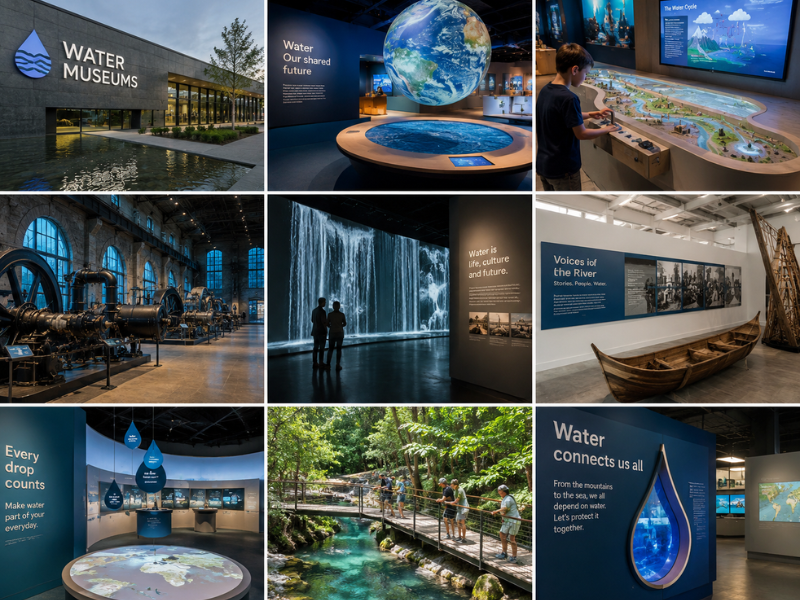
Water museums are no longer a small or isolated niche. According to UNESCO, the Global Network of Water Museums comprises 89 institutions across 38 countries, collectively educating around 10 million visitors each year on subjects ranging from water science to the ways water is used in everyday life.
That educational role is becoming increasingly important as water management and climate disruption become more closely connected. At the 10th World Water Forum in Bali in 2024, UNESCO highlighted education and public awareness as one of three core priorities for improving global water security and resilience, alongside international cooperation and better water knowledge and data.
Water museums are also moving beyond awareness towards conversations about adaptation. In November 2025, WAMU-NET’s sixth international conference in Brasília focused specifically on adapting to climate change and how museums and communities could contribute to more resilient futures. Discussions explored education, participatory approaches, Indigenous and local knowledge, and new ways of communicating how societies can respond to changing water conditions.
The shift is significant. Many water museums are moving beyond preserving stories about how people managed water in the past. Increasingly, they are becoming places to explore how we might live with water in an uncertain climate future.
Turning Climate Data Into Something We Can Feel
Climate data can show us how quickly the planet is changing. Making those numbers feel meaningful is another challenge.
In Venice, Water Dream Memory offered a different approach. Hosted at Palazzo Zorzi, home of the UNESCO Office in Venice, from May to June 2026, the exhibition saw artists Sara Bonaventura and Lukas Taido translate scientific data into visceral imagery and spatial experiences. Water appeared through presence, absence and memory, reflecting the uncertainty of today’s ecological crisis.
Rather than relying on technical explanations or familiar images of catastrophe, the exhibition created immersive “zones of attention,” inviting visitors to slow down and consider water as something shaped by time, circulation and care.
It shows how climate storytelling can move beyond facts on a display. By bringing science and art together, exhibitions like Water Dream Memory can translate environmental change into spatial and sensory experience, and perhaps remember long after they leave.
The Museum Without Four Walls
Even the idea of what constitutes a museum is changing.
In Greece, work underway in 2026 on an Extended Museum of the Acheron River is exploring a model in which landscape, communities and local water knowledge become part of the museum experience itself.
Meanwhile, Italy opened the Spazio Mefite Interpretation Center in Campania in June 2026. Centered on the Upper Tammaro River, its eight sections connect biodiversity and historic hydraulic infrastructure with ecosystem services, community-based water management and even the idea of rivers as legal entities. Two digital itineraries take the experience into the surrounding landscape, allowing visitors to explore the area’s geological history on foot.
The museum, in other words, no longer necessarily ends at its doors.
Ancient Knowledge Meets a Digital Future
Some of the newest climate stories are also among humanity’s oldest.
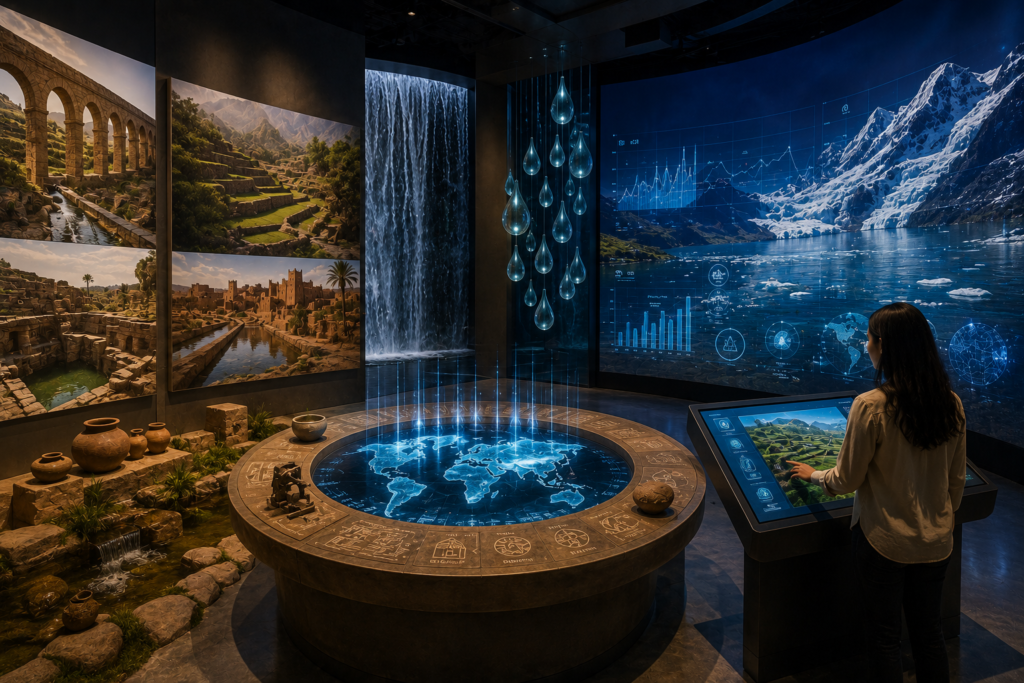
UNESCO’s virtual exhibition, The Voices of Water, presents eight ancient water-management systems from Morocco to Australia, including Iraq, Peru, and Ghana. Rather than presenting them simply as relics of the past, the exhibition explores how ancient and Indigenous knowledge could inspire more sustainable approaches to today’s water challenges.
That perspective becomes particularly relevant when UNESCO reports that two billion people depend on mountain waters, while mountain glaciers could lose 26-41% of their 2015 mass by 2100 under warming of 1.5-4°C.
Innovation does not always require starting from scratch. In some places, older systems of water management offer principles that remain relevant under changing environmental conditions.
From Museum Visitors to Climate Storytellers
There is another change underway: museums are no longer doing all the talking.
Film has become part of the movement too. On 12 November 2025, during COP30 in Belém, the winning films from the Back To Our Future Water Film Prize were screened at the Museu de Arte de Belém, bringing stories of traditional water knowledge and climate resilience into the wider climate conversation. Films from countries including Kenya, Iran, Pakistan, Tunisia, Chad, Morocco and China explored traditional water knowledge and its relevance to climate resilience.
The choice of venue was significant, but so was the timing. Water-museum storytelling had traveled beyond the museum and into the orbit of one of the world’s most consequential climate negotiations.
It suggests a transition from museums as places where environmental knowledge is stored to platforms where communities, filmmakers, scientists and cultural knowledge holders can participate in shaping it.
Can a Museum Change Our Relationship With Water?
The challenge facing water museums is enormous.
No exhibition can stop a glacier melting. An immersive installation cannot refill a drought-stricken river. A film cannot hold back a rising sea.
But museums can influence what lies behind many environmental decisions: how people understand water in the first place.
A river can be infrastructure, habitat, memory, a sacred landscape, and a climate warning simultaneously. By connecting those stories, museums can make climate change less abstract.
Perhaps that is the real significance of this new wave of water museums.
They are no longer simply asking us to remember how people once lived with water.
Increasingly, they are asking us to imagine how we will live with it next.
Read More on: